TheSparseLabs is a small product lab. We find what quietly ruins a workday and build the smallest thing that stops it.
Nothing ships that can’t ship in 15 days. That isn’t a schedule. It’s a filter — if an idea can’t survive being that small, it isn’t the right idea yet.
Four steps. We run them again the moment we’re done.
We start from friction, not from ideas. Someone doing real work hits the same wall for the fourth time and works around it instead of complaining. That workaround is the brief.
Then we take things away. What is the smallest version that actually ends the problem? If the answer needs a roadmap, it’s the wrong problem or we haven’t understood it yet.
Fifteen days, and it goes out. Small enough to finish, real enough to use. Not a beta list, not a waitlist — a thing you can open.
Then we find out whether we were right. People use it or they don’t, and both answers are useful. Some products get a second fifteen days. Some get put down.
We run them again the moment we’re done.
The loop doesn’t care what form the answer takes. Some problems need an application. Some need one endpoint. Some need a command you type once and forget about.
Full products that live in a browser. Real software, not a landing page with a form behind it.
For the problems that only happen away from a desk. Shops, sites, vans, waiting rooms.
reading invoiceswrote invoices.csvdoneSometimes the honest answer to a problem is forty lines you run in a terminal. No dashboard, no account, no onboarding — it just does the thing and exits.
{ "results": [...], "coverage": "partial"}Infrastructure for other people’s software. If the thing that hurts is something your own product needs and can’t get, we’ll build the service rather than the interface.
Small, single-purpose tools that open in a tab and solve exactly one thing. No signup, no install. You use it, it works, you close it.
We pick the shape after we understand the problem, never before. Deciding you’re building a mobile app and then going looking for a reason is how the year-long roadmaps start.
Three products, three different shapes. A whiteboard, a shop till, and a search API. What they have in common is the loop, not the category.
Web app
Live
What hurts
You’re designing a database and the diagram lives in one tool, the schema in another. They drift apart within a week, and the diagram becomes a lie.
What it does
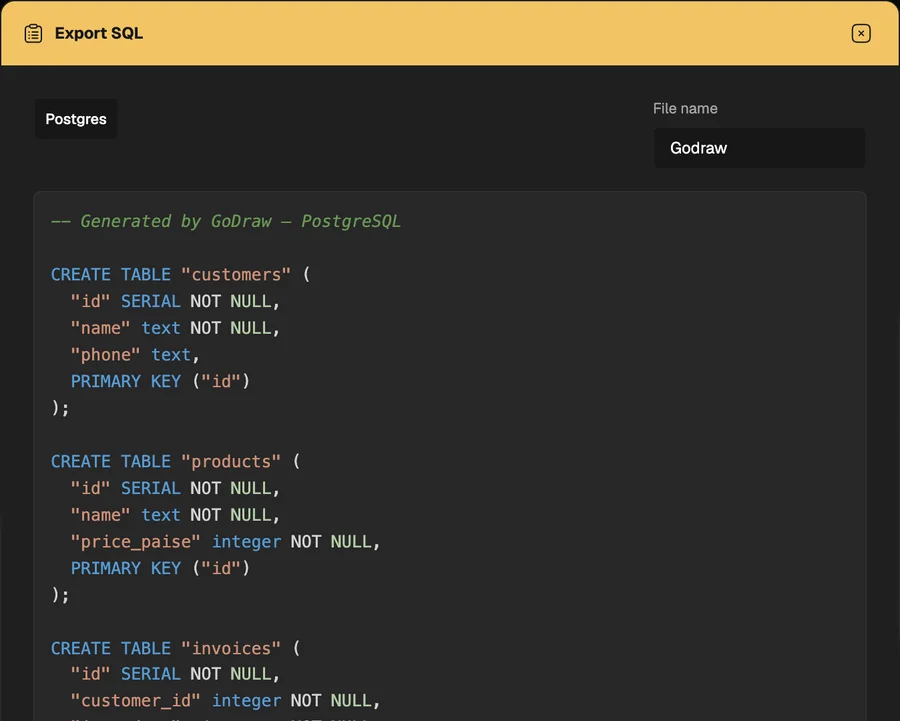
An infinite canvas for drawing systems. Draw the tables in crow’s-foot notation and export SQL you can actually run — Postgres, MySQL, SQLite. Or point it at a schema you already have and get the diagram back.
Desktop app with a cloud API
In development, built in the open
What hurts
The shop’s internet drops and the till stops taking money. Cloud billing software assumes a connection that a lot of Indian retail simply doesn’t have.
What it does
Billing, inventory and accounting for Indian retail and wholesale shops, built offline-first. The shop’s own computer is the system of record. The cloud is for backup and reporting, not for permission to make a sale.
Your business keeps running even when the internet doesn’t.
API
Launching soon
What hurts
Agents are only as good as the web context they can pull in, and most tools scrape someone else’s search results — which means a latency floor, a dependency that can cut you off, and no real retrieval.
What it does
A web search and extraction API for AI agents, built on our own index rather than somebody else’s results page. Search the live web, pull clean Markdown out of any page, get answers you can check.
Close enough that we’re arguing about the docs rather than the code.
In progress
Several things are mid-build right now. Some will make it out, some won’t — that’s what the loop is for. The ones that survive land here with a date on them.
Ongoing
More SaaS and micro-SaaS. More command-line tools. More endpoints, more mobile, more small things that open in a tab. Every shape above has something behind it — this row is where they’ll appear once they’re real enough to have a date.
The ledger shows the cadence. This shows the work.
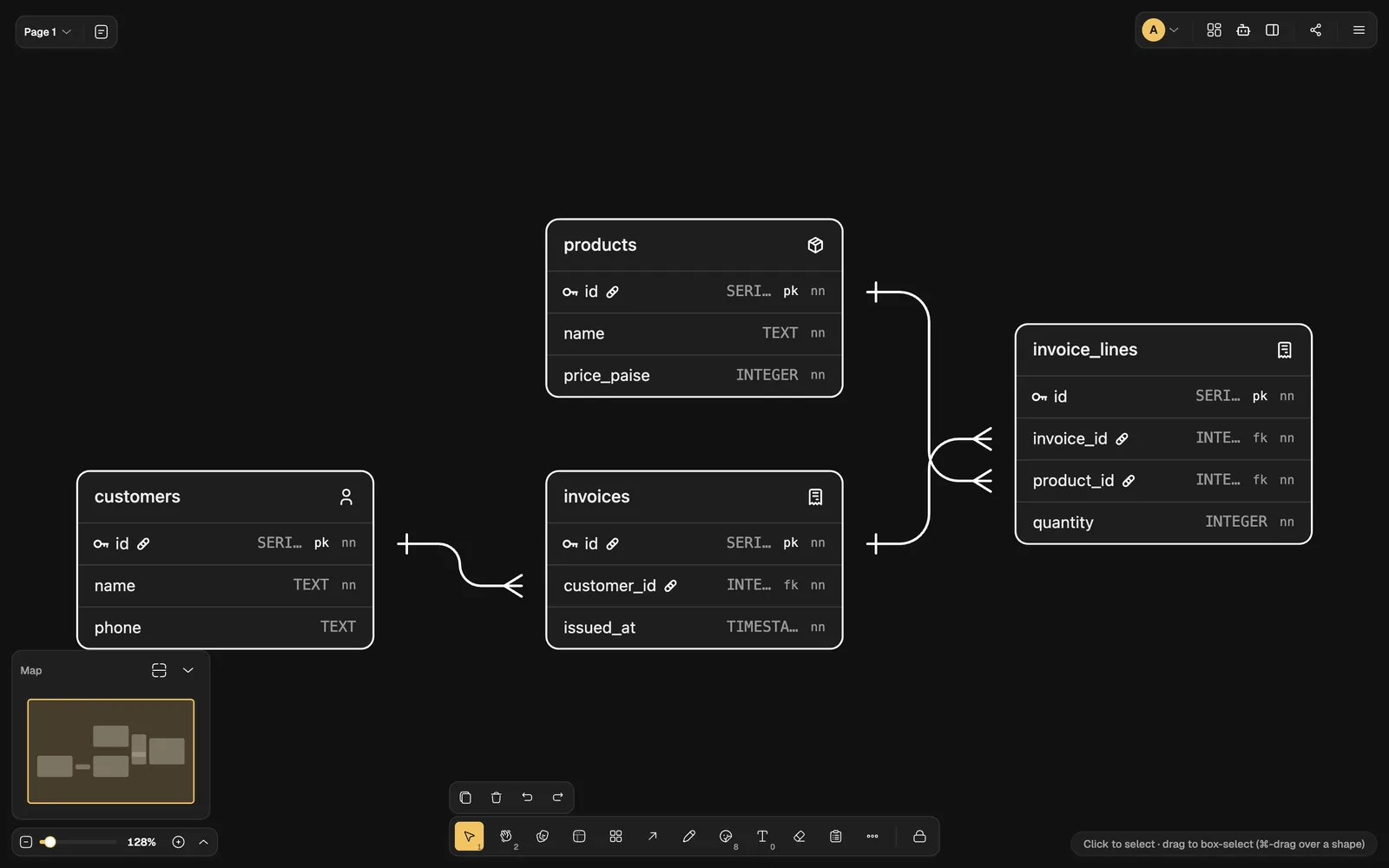

Every developer has drawn the same database twice. Once in the diagramming tool, to think. Once in SQL, to build. Then the schema changes and only one of them gets updated, so the picture on the wall slowly becomes fiction.
Godraw collapses that into one step. Draw the tables, the columns, the keys and the relationships in proper crow’s-foot notation, and export DDL that runs on Postgres, MySQL or SQLite. Already have a schema? Import it and get a diagram that matches reality, because it came from reality.
Around that sits an ordinary, good infinite canvas — freehand, shapes, arrows that route themselves, sticky notes, mind maps, code blocks, math. Live cursors and voice chat when you’re working with someone. A presentation mode for when the sketch becomes the meeting. And it works offline, syncing when you’re back.
“Free and always will be. If it saved you time, a small tip funds the servers and the next feature.”